
Building a SaaS product in 2026 requires clarity, speed, and a strategic approach. The competition is more intense than ever, user expectations are higher, and the market moves fast. Many founders invest months or even years building a full SaaS solution, only to discover that customers didn’t want half of the features they spent time and money creating. That’s why the MVP (Minimum Viable Product) approach remains the smartest path to launching a SaaS product with confidence.
A SaaS MVP helps you validate your idea early, avoid unnecessary expenses, and build exactly what users want. Instead of creating a fully polished product from day one, you focus on the core problem your SaaS solves and release a simplified version to real users. This approach shortens your go to market timeline, reduces risk, and increases your chances of reaching product market fit.
This guide will show you everything you need to know from idea validation and feature prioritization to design, development, testing, launch, and post launch scaling.
What Is a SaaS MVP? Understanding the Foundation
A SaaS MVP is a working version of your software that includes only the essential features your users need to solve their primary problem. It is not a rough sketch or a prototype. It is a functional product that real people can use, test, and evaluate. The purpose is not to build something “minimal” the purpose is to build something meaningful.
An MVP allows you to put your idea into the world quickly and collect insights directly from your users. You learn what works, what doesn’t, what needs improvement, and what features truly matter. It prevents wasted investment and helps ensure you are building a product that people actually want, not what you assume they want.
Global SaaS leaders like Slack, Airbnb, and Dropbox all began with extremely simple MVPs. Their success didn’t come from building everything at once. It came from focusing intensely on solving one problem extremely well.
Why Start With an MVP Instead of a Full Product
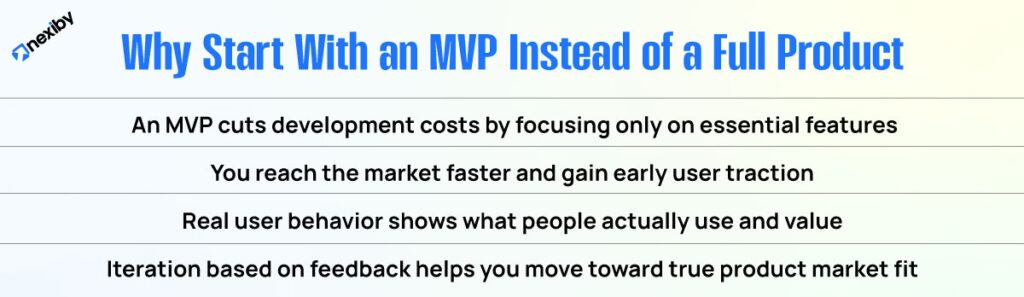
Launching a full SaaS product without user validation is one of the biggest risks especially in 2026. Startups fail not because they can’t build the product, but because they build the wrong product. An MVP protects you from this by giving you a low risk environment to test your assumptions.
There are several powerful reasons founders start with an MVP:
You save money
Instead of spending 80K–200K on a large project, you begin with a much smaller investment while still proving your idea.
You launch faster
Speed matters. While competitors are still planning, you enter the market, gather users, and build momentum.
You test real user behavior
People often say they want something but their actual behavior tells a different story. The MVP reveals the truth.
You reduce the chance of failure
Every feature added without validation increases risk. An MVP helps you avoid unnecessary complexity.
You move closer to product market fit
Instead of building blindly, you iterate based on feedback and data, not guesses.
Validate Your SaaS Idea Before Building Anything
Before you start designing screens or writing code, you must ensure your SaaS idea solves a real problem. Many founders fall in love with their idea, skipping validation. This leads to slow growth or complete failure. Validation forces you to look beyond your assumptions and understand what the market truly needs.
Effective validation involves different methods:
Talk to real users
Reach out to the people you want to serve. Have conversations about their struggles, their workflows, and the tools they currently use. Ask open ended questions that reveal pain points.
Study your competitors
Understanding competitors helps you identify gaps. Maybe they lack automation. Maybe their UI is outdated. Maybe their pricing is too high. Every weakness is an opportunity.
Analyze demand
Use tools such as Google Keyword Planner, Ahrefs, Reddit, Facebook groups, and industry forums. If people repeatedly complain about a problem, the demand is real.
Test your value proposition
Try to explain your SaaS idea in one sentence. If it feels complicated, the idea may need refinement.
Validation ensures that your product is built for a market that needs it not a market you hope exists.
Identify the Core Features Your MVP Truly Needs
One of the biggest challenges in MVP development is deciding what to build now and what to save for later. Founders often want to add every exciting idea immediately but this leads to feature overload and slow development. An effective MVP focuses on the essential actions users must take to achieve their main goal.
To identify your MVP’s core features:
Break down your product into the most essential problem it solves
For example, if your SaaS is a CRM, the core problem is managing contacts not advanced automation or reporting.
Prioritize features using frameworks
Tools like MoSCoW (Must, Should, Could, Won’t) or the Kano model help you determine what matters most.
Ask yourself
- Can the MVP function without this?
- Does this directly help the user achieve their main goal?
- Does this feature validate a key assumption?
- Can this feature wait for version 2?
Keep the MVP small but powerful
Your goal is to deliver value with the minimum amount of development. If users cannot achieve their primary outcome, you don’t have an MVP. If the MVP tries to do too much, you lose focus.
Map User Stories & Create a Smooth User Journey
User stories and journey mapping help transform ideas into functional workflows. They guide developers and designers to understand the user’s perspective and ensure that the MVP feels intuitive and easy to use.
A user story explains what a user wants to do and why:
- “As a user, I want to sign up quickly so I can access my dashboard without confusion.”
- “As a manager, I want to assign tasks easily so my team stays organized.”
Once user stories are clear, map the user journey:
- What happens when they sign up?
- What is the first screen they see?
- What steps do they take to complete the core task?
- How does the system guide them?
The user journey should feel natural, frictionless, and simple. If the user gets stuck, confused, or overwhelmed, your MVP may fail even if the features are useful.
Design a Clean, Simple, and Intuitive UI/UX
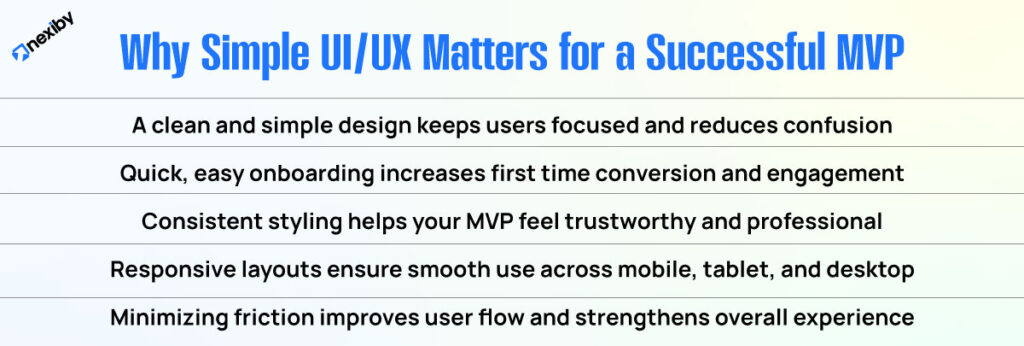
Your MVP doesn’t need a complex interface or high end visuals. But it needs clarity. A confusing design can drive users away within seconds, even if your product solves a real problem. In 2026, users expect clean layouts, easy navigation, and clear instructions.
To achieve this:
Focus on simplicity
Use whitespace to avoid clutter. Keep button labels simple. Avoid unnecessary animations.
Make onboarding effortless
A short sign up process increases conversions. Include tooltips or a brief tutorial for clarity.
Use consistent styling
The MVP should feel like a real product, not a temporary draft. Consistency builds trust.
Design for all devices
Responsive design isn’t optional. Users expect the MVP to work on mobile, tablet, and desktop.
Eliminate friction
If users need more than a few clicks to complete the main action, refine the flow.
A good UX can compensate for missing features. A bad UX can destroy a great product.
Choose the Right Tech Stack for Your SaaS MVP
Choosing your tech stack is an important decision because it affects your development speed, scalability, cost, and long term maintainability. The best tech stack is not the one with the trendiest tools, it’s the one that fits your product and your team’s strengths.
Frontend frameworks
- React
- Next.js
- Vue.js
These options allow fast development, smooth performance, and great scalability.
Backend technologies
- Node.js
- Laravel
- Django
- Ruby on Rails
Databases
- PostgreSQL
- MySQL
- MongoDB
- Firebase
Cloud hosting
- AWS
- DigitalOcean
- Vercel
- Render
- Google Cloud
Choosing a tech stack should balance speed of development with scalability. Your MVP should be quick to build but also ready to scale when you gain traction.
Build Your SaaS MVP Using Agile, Lean, and Fast Workflows
The way you manage your development process will determine how quickly and efficiently your MVP launches. Agile methodology allows your team to build in short cycles, test frequently, and adjust quickly.
Work in small sprints
Break the project down into weekly or biweekly tasks. This keeps the team focused and ensures constant progress.
Review progress often
Daily or weekly stand ups help identify issues early.
Document everything
Clear documentation avoids confusion, especially when adding new team members.
Keep the scope tight
Avoid feature creep. Stick to the MVP plan.
The faster you ship, the sooner you learn. The sooner you learn, the better your final SaaS product will be.
The MVP Development Process (From Concept to Launch)
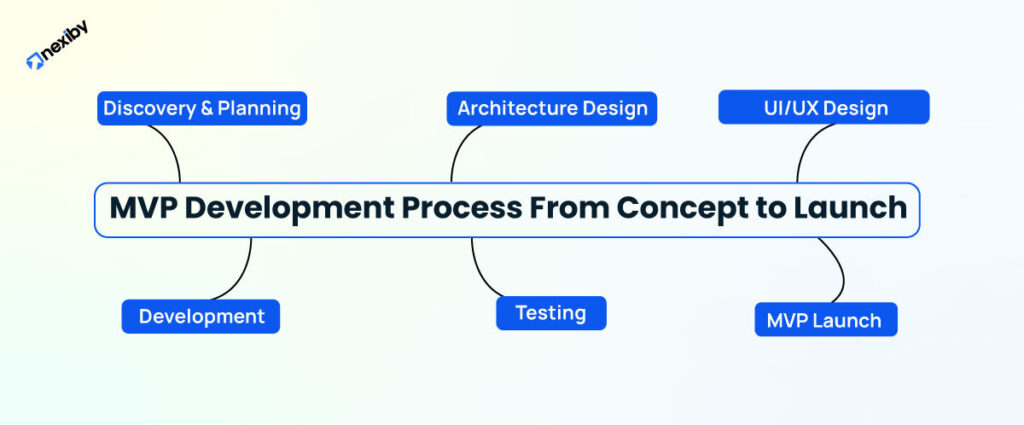
A successful MVP follows a clear, predictable development process. This ensures every stage is organized and aligned with your goals.
1. Discovery & Planning
Define the problem, audience, and core outcomes. Outline user stories and choose the tech stack.
2. Architecture Design
Plan the structure, modules, system logic, and database setup. Good architecture helps you scale later.
3. UI/UX Design
Create wireframes, mockups, and screens. Focus on clarity, simplicity, and usability.
4. Development
Build the backend, frontend, API connections, dashboard, login flow, and essential features.
5. Testing
Fix bugs, optimize performance, test usability, and evaluate user flow.
6. MVP Launch
Release your MVP to a limited audience or early adopters to begin gathering insights.
This structured flow keeps your team aligned and reduces development mistakes.
Test Your MVP Thoroughly Before Launching
Testing ensures your MVP delivers a clean, smooth experience. Even the best features lose value if they break, crash, or confuse the user.
Usability testing
Observe how first time users interact with your MVP. Identify bottlenecks or confusing steps.
Functionality testing
Verify that every feature works as expected.
Performance testing
Ensure the product loads fast and handles basic user activity without lag.
User acceptance testing
Invite real users to test the MVP and give feedback.
Launching without testing damages credibility and slows adoption.
Launch Your MVP Strategically in 2026
Launching your MVP is not about going viral, it’s about learning. A strategic launch helps you gather the right insights from the right users.
There are two effective launch approaches:
Soft Launch
Release to a small group of early users. This helps identify issues and gather deep feedback.
Public Launch
Release broadly through channels like Product Hunt, LinkedIn, Reddit, Twitter, or niche communities.
Effective launch tactics
- Build a waiting list
- Offer early access discounts
- Share your roadmap publicly
- Create educational content (blogs, videos)
- Collect testimonials from early users
A successful launch is one that teaches you how to improve your SaaS.
Measure Your MVP’s Success With Key Metrics
Metrics tell you whether your MVP is working as intended. Instead of guessing what to build next, rely on data.
Important SaaS MVP metrics include:
Activation Rate
How many users complete the main action?
Retention Rate
Do users return after signing up?
Feature Usage
Which features are being used the most?
Churn Rate
Why do some users leave?
Customer Feedback
What improvements do they request?
Metrics guide your future product decisions and help shape your roadmap.
Improve, Iterate, and Scale After Launch
Your MVP is only version 1. The real journey begins after launch. Once you have user feedback and usage data, you can begin improving your SaaS product.
Iterate frequently
- Add needed features
- Remove unnecessary elements
- Improve onboarding
- Optimize user flow
Scale gradually
Once your metrics improve and users show consistent engagement, begin adding advanced features and strengthening infrastructure.
Great SaaS products evolve through continuous iteration, not by building everything upfront.
Common Mistakes Founders Make When Building an MVP
Avoiding common mistakes will save time, money, and frustration.
Mistakes to avoid:
- Building too many features
- Ignoring user interviews
- Poor UI/UX design
- Overcomplex tech stack
- Skipping testing
- Not validating pricing
- Avoiding early user feedback
These mistakes slow down growth and ruin your chances of achieving product market fit.
How Much Does a SaaS MVP Cost in 2026?
MVP development costs vary based on complexity, team location, tech stack, and timeline. But in 2026, development is more optimized, and teams are more specialized.
Typical cost ranges:
Basic MVP: $8,000 – $15,000
Medium MVP: $15,000 – $35,000
Complex MVP: $35,000 – $60,000+
Costs depend on:
- Number of features
- UI/UX quality
- Custom integrations
- Speed of development
- Team experience
Understanding cost early helps founders budget better.
How Long Does MVP Development Take?
A realistic development timeline helps set expectations.
Typical timelines:
Simple MVP: 4–6 weeks
Moderate MVP: 6–10 weeks
Complex MVP: 10–16 weeks
Speed comes from a focused scope, clear user stories, and consistent communication.
Building In House vs Outsourcing What’s Best
Both in-house teams and outsourcing have advantages. The right choice depends on your resources and goals.
Build in house if:
- You already have developers
- You have time to manage the project
- You want full control
Outsource if:
- You want faster delivery
- You lack technical expertise
- You want predictable costs
- You want experienced SaaS professionals
Outsourcing is often the better choice for early stage founders who need speed and expertise.
Conclusion
Building a SaaS MVP in 2026 is not just about creating a product quickly. It’s about understanding your market, validating your assumptions, and building something that users genuinely care about. The MVP approach helps you learn faster, reduce risk, and move closer to product market fit with every iteration.
If you want to build a SaaS MVP that users love, stay focused on the core problem, launch early, learn deeply, and grow deliberately. That’s the modern formula for SaaS success.
FAQs
What is SaaS MVP development?
– SaaS MVP development is the process of building a basic version of a SaaS product with only essential features. It helps founders launch quickly, test real user feedback, and validate demand before investing in full development.
What is MVP in software development?
– An MVP in software development is the simplest usable version of a product that solves a core problem. It allows teams to launch fast, reduce costs, and learn what users truly need.
What comes first, PoC or MVP?
– A PoC comes first. It checks if the idea is technically possible. Once the PoC works, an MVP is built to test real user demand and gather feedback.
How long does it take to build a SaaS MVP?
– Most SaaS MVPs take 4–12 weeks to develop depending on complexity, features, and team size.
What features should be included in a SaaS MVP?
– A SaaS MVP should include only the core features needed to solve the main user problem while leaving advanced functionality for later versions.