

As startups grow, technical decisions that once felt small begin to shape the future of the entire business. One of the most important of these decisions is architectural: should you continue with a monolithic application, or is it time to move toward microservices architecture?
This question does not have a one-size-fits-all answer. Moving too early can slow your team down. Waiting too long can create bottlenecks that limit growth. The goal is not to follow trends, but to choose an architecture that supports your product, your team, and your customers at the right stage of growth.
This guide explains the transition from monolith to microservices in simple, practical terms. It focuses on real startup scenarios, business impact, and technical trade-offs so you can make an informed decision.
What Monolithic Architecture Really Means for Startups
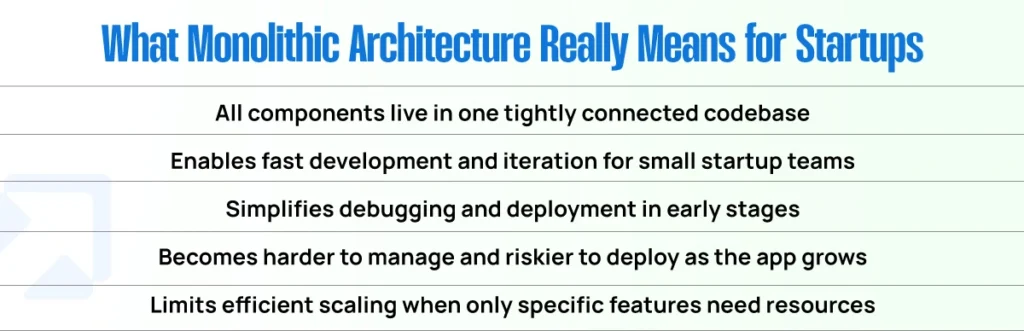
A monolithic architecture is a single application where all components are tightly connected. The user interface, business logic, and database interactions live in one codebase and are deployed together. For early-stage startups, this approach makes perfect sense.
In the beginning, speed matters more than structure. A monolithic application allows small teams to build features quickly, test ideas, and iterate without worrying about complex infrastructure. Debugging is simpler because everything lives in one place, and deployments are straightforward.
However, as a startup grows, the same simplicity that once helped can start to work against the team. The codebase becomes larger, deployments become riskier, and even small changes require full application releases. Scaling also becomes inefficient because the entire application must scale together, even if only one feature needs more resources.
This does not mean monoliths are bad. Many successful companies run large monolithic systems for years. The problem arises when growth demands flexibility that a monolith was never designed to provide.
Understanding Microservices Architecture in Simple Terms
Microservices architecture takes a very different approach. Instead of one large application, the system is divided into smaller, independent services. Each service is responsible for a specific business function and communicates with other services through APIs.
For example, user authentication, payments, notifications, and reporting can all be separate services. Each service can be developed, deployed, and scaled independently. This separation allows teams to work in parallel and reduces the risk that a single failure will take down the entire system.
Microservices are especially attractive to fast-growing startups because they support scalability, resilience, and team autonomy. But they also introduce complexity. Distributed systems require strong DevOps practices, monitoring, and communication between services.
This is why microservices are powerful but only when the organization is ready for them.
Monolith vs Microservices: How the Difference Feels in Real Life
In a monolithic system, a small change to one feature can affect many parts of the application. Testing takes longer, and deployments feel stressful because everything ships together. When traffic increases, the only option is to scale the entire system, which increases infrastructure costs.
In a microservices system, teams can deploy changes independently. A problem in one service is less likely to impact others. High-traffic features can scale without affecting the rest of the platform. Over time, this leads to faster development cycles and better system reliability.
That said, microservices come with operational overhead. You must manage service communication, handle failures gracefully, and invest in logging and monitoring. For startups without DevOps maturity, this can become a burden rather than a benefit.
Clear Signals It’s Time to Move Beyond a Monolith
One of the most common mistakes startups make is migrating based on hype instead of need. The decision should be driven by real pain points.
If your team struggles to release features quickly because deployments are slow and risky, your monolith may be limiting development velocity. When scaling one part of the application requires scaling everything, infrastructure costs rise without real efficiency. As engineering teams grow, code ownership becomes unclear, and onboarding new developers takes longer.
Reliability issues are another strong signal. If a single bug or traffic spike brings down the entire application, your architecture lacks proper isolation. Microservices can reduce this risk by containing failures within individual services.
These challenges often appear together. When they do, it’s a sign that your startup may be ready to explore a more modular, scalable architecture.
When Microservices Are the Wrong Move
Despite their advantages, microservices are not always the right choice. If your startup is still validating its product, frequent architectural changes can slow progress. Early teams benefit more from simplicity than from scalability.
Microservices also require experienced engineers who understand distributed systems. Without the right skills and processes, teams can spend more time managing infrastructure than building features.
If your monolithic application is still easy to understand, deploy, and scale, there is no urgency to migrate. Architecture should support growth, not distract from it.
Migrating the Right Way- Gradual, Not Disruptive
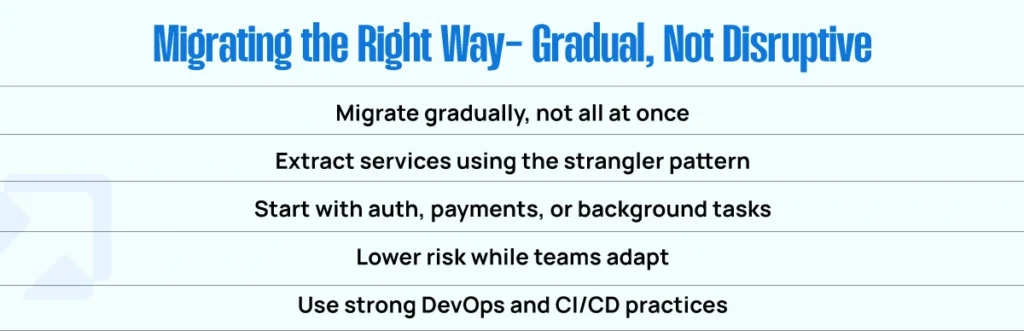
A successful transition does not involve rewriting the entire system overnight. The most effective approach is gradual migration.
Many startups use the “strangler” pattern, where individual services are extracted from the monolith one at a time. This allows teams to learn, adapt, and reduce risk. Common starting points include authentication, payments, or background processing areas that naturally benefit from isolation.
Strong DevOps practices are essential during this phase. Continuous integration, automated testing, monitoring, and clear deployment pipelines reduce friction and ensure reliability as the system becomes more distributed.
How Nexiby Supports Architecture Decisions
Choosing between monolithic and microservices architecture is not just a technical choice, it’s a business decision. At Nexiby, we work closely with growing startups to align architecture with growth goals, team capabilities, and long-term vision.
Our approach focuses on clarity, not complexity. We assess your current system, identify real bottlenecks, and recommend whether optimization, partial migration, or a hybrid approach makes the most sense. Instead of pushing trends, we design solutions that fit your stage of growth.
If your startup is unsure whether its current architecture can support the next phase of growth, Nexiby can help you plan, design, and execute a scalable path forward. Reach out today to get expert guidance tailored to your product.
Cost, Security, and Long-Term Impact
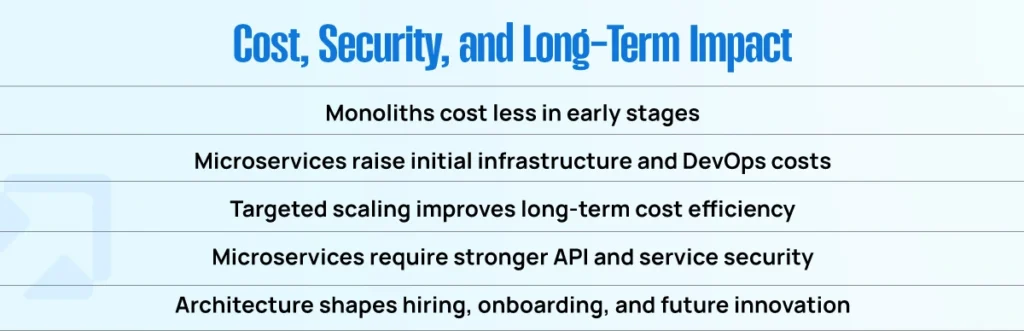
From a cost perspective, monoliths are cheaper early on because they require less infrastructure and fewer operational tools. Microservices increase costs initially due to cloud usage, monitoring systems, and DevOps investment. However, at scale, microservices often become more cost-efficient by allowing targeted scaling.
Security also changes with architecture. Microservices require stronger API security and service-to-service authentication. When done correctly, they can improve security by limiting access and isolating sensitive functionality.
In the long term, architecture affects hiring, onboarding, and innovation. A well-designed system monolithic or microservices creates a foundation for sustainable growth.
Final Thoughts
There is no universal rule for when a startup should move from monolith to microservices. The right time depends on growth, complexity, team size, and business goals.
Monolithic architecture is often the best choice early on. Microservices become valuable when scale, reliability, and speed demand a more modular approach. The key is making the transition intentionally, with clear reasons and a solid plan.
If your startup is experiencing growing pains, architectural clarity can be the difference between slowing down and scaling confidently.
Frequently Asked Questions (FAQs)
1. Can a startup scale successfully with a monolithic architecture?
Yes. Many startups grow significantly on a monolith before needing microservices.
2. What is the biggest risk of switching to microservices too early?
Increased complexity, higher costs, and slower development.
3. Do microservices automatically improve performance?
Not always. They improve scalability and reliability when designed properly.
4. How long does a migration usually take?
Most successful migrations are gradual and take months or longer.
5. Should business leaders be involved in architecture decisions?
Absolutely. Architecture directly affects cost, speed, and customer experience.