For more than a decade, Software-as-a-Service (SaaS) dominated enterprise technology decisions across the United States. Cloud subscriptions promised faster deployment, predictable monthly costs, and freedom from maintaining complex infrastructure. From CRM and ERP systems to HR platforms, analytics tools, and collaboration software, SaaS became the default choice for organizations of all sizes.
But in 2026, a clear shift is underway. US enterprises are increasingly moving beyond generic SaaS platforms and reinvesting in custom proprietary software. This change is not driven by resistance to cloud technology or digital transformation. Instead, it reflects a deeper understanding of long-term business value, operational control, security, scalability, and cost efficiency.
What once looked like flexibility now feels like constraint. What once felt affordable now feels expensive. As enterprises mature, their technology needs evolve, and many are discovering that SaaS tools no longer align with their strategic goals.
How SaaS Became the Default Choice for US Enterprises
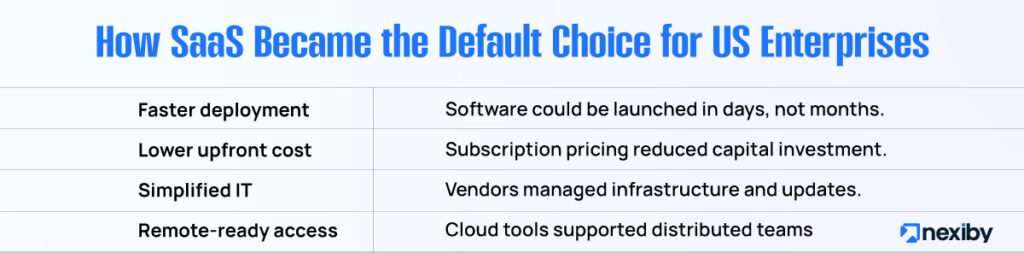
The rise of SaaS was fueled by genuine advantages. SaaS platforms reduced time to market, eliminated heavy upfront investment, and simplified software adoption. For startups and growing businesses, these benefits were transformational. Teams could deploy tools in days rather than months and focus on growth instead of infrastructure.
US enterprises adopted SaaS aggressively during the cloud boom, particularly between 2010 and 2020. Vendors positioned SaaS as scalable, secure, and cost-effective, and in many cases, those claims were valid. SaaS enabled rapid digital transformation, especially during periods of remote work and global disruption.
However, SaaS was designed to solve common problems at scale. As enterprises grew more complex, the limitations of one-size-fits-all software became increasingly visible.
The Hidden Cost of SaaS at Enterprise Scale
At a small scale, SaaS feels economical. At enterprise scale, the economics change dramatically. Subscription fees accumulate year after year, and pricing models tied to users, data volume, or feature tiers create unpredictable costs.
Many US enterprises now operate with dozens, sometimes hundreds, of SaaS tools across departments. Each tool may be affordable in isolation, but together they form a costly and fragmented ecosystem. Finance leaders are discovering that SaaS spending often grows faster than revenue.
Beyond direct costs, enterprises face indirect expenses. Integration maintenance, workflow inefficiencies, duplicate data entry, and training overhead all add to the true cost of SaaS. Over a five- to ten-year period, SaaS total cost of ownership often exceeds expectations.
This realization has pushed enterprises to reconsider whether renting software indefinitely is the best long-term strategy.
SaaS Fatigue and Operational Complexity
SaaS fatigue is now a common term among US enterprise leaders. It refers to the growing frustration caused by managing too many tools, subscriptions, dashboards, and vendors. Each platform introduces its own logic, limitations, and update cycle.
Enterprise decision-makers in the US are increasingly experiencing SaaS fatigue, a condition where too many tools, subscriptions, and integrations create inefficiency rather than productivity.
Based on industry data referenced in both competitor analyses:
- US enterprises use 90+ SaaS tools on average
- Subscription costs grow 15–25% annually
- 30–40% of SaaS features go unused
- Switching costs increase every year due to data lock-in
This lack of control creates risk. Enterprises depend on vendors for uptime, roadmap decisions, and compliance updates. Over time, this dependency conflicts with the need for agility and resilience.
What Custom Proprietary Software Means Today
Custom proprietary software is often misunderstood. Many decision-makers still associate it with slow development cycles, high risk, and outdated methodologies. In reality, modern custom software development is faster, more modular, and more cloud-native than ever before.
Today’s custom software leverages the same infrastructure SaaS vendors use: cloud platforms, containerization, APIs, automation, and continuous deployment. The difference lies in ownership and intent. Custom proprietary software is built specifically for one organization’s workflows, data models, and strategic priorities.
Rather than forcing a business to fit predefined software logic, custom software molds technology around the business itself.
Why US Enterprises Are Moving Beyond SaaS
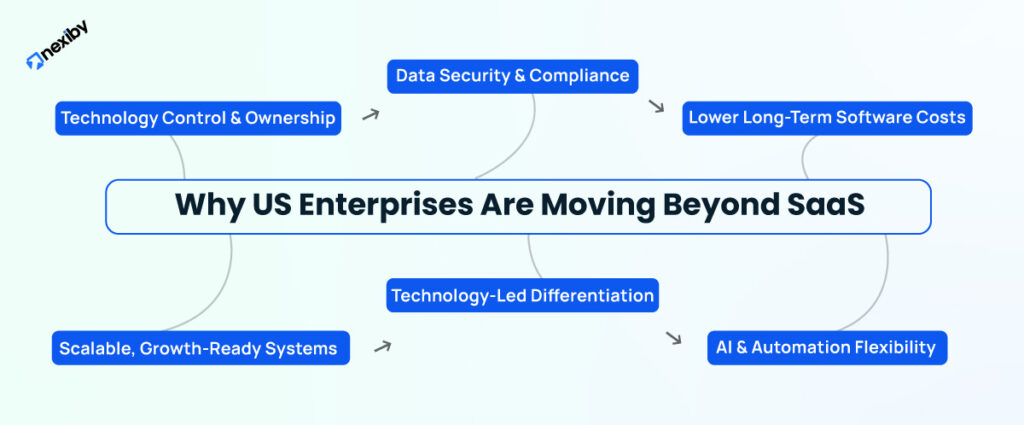
1. Control Over Technology and Decision-Making
One of the strongest drivers behind the shift away from SaaS is the desire for control. SaaS vendors control product roadmaps, feature availability, and update schedules. Enterprises are often forced to adapt when vendors make decisions that do not align with their needs.
Custom proprietary software puts control back in the hands of the enterprise. Organizations decide what to build, when to update, and how systems evolve. This autonomy becomes increasingly important as enterprises differentiate their operations and customer experiences.
In competitive US markets, even minor operational advantages can create meaningful differentiation. Custom software enables enterprises to protect those advantages.
2. Data Ownership and Security in a Regulated Environment
Data has become one of the most valuable assets for US enterprises. At the same time, regulatory requirements around data privacy, security, and governance continue to increase. Industries such as healthcare, finance, insurance, and legal services face strict compliance obligations.
SaaS platforms typically store data in shared environments. While secure, these environments limit visibility and control. Enterprises often have little insight into internal vendor processes or data handling practices.
Custom proprietary software allows enterprises to design security and compliance into the architecture itself. Data residency, encryption standards, access control, and audit trails are defined internally. This reduces regulatory risk and builds trust with customers and partners.
3. Long-Term Cost Efficiency and Predictability
While SaaS reduces upfront investment, it introduces ongoing operational expenses that can escalate over time. Subscription increases, usage-based pricing, and feature gating all contribute to rising costs.
Custom software requires initial investment, but US enterprises increasingly evaluate technology decisions through a long-term lens. Over five to ten years, custom proprietary software often delivers lower total cost of ownership by eliminating recurring subscription fees and reducing dependency on multiple vendors.
Cost predictability is another major advantage. Enterprises can budget for maintenance and enhancements without worrying about sudden pricing changes imposed by third parties.
4. Flexibility and Scalability Aligned With Business Growth
SaaS platforms scale according to vendor-defined models, often tied to users or data volume. This can penalize growth rather than support it. Enterprises may find themselves paying more simply for expanding teams, even when productivity gains are marginal.
Custom proprietary software scales according to business needs. Enterprises choose how systems expand, which features evolve, and how infrastructure grows. This flexibility is especially valuable for organizations planning mergers, acquisitions, or new market expansion.
Custom software aligns scalability with strategy, not pricing tiers.
5. Competitive Differentiation Through Technology
Generic SaaS platforms standardize workflows across industries. While this can improve efficiency, it also reduces differentiation. When competitors use the same tools, processes become similar, and innovation slows.
Custom proprietary software enables enterprises to embed unique logic, automation, and analytics into their operations. This creates internal efficiencies and customer experiences that competitors cannot easily replicate.
For US enterprises competing nationally or globally, technology differentiation is no longer optional. It is a core strategic lever.
6. AI, Automation, and Advanced Analytics
Artificial intelligence and automation are reshaping enterprise operations. While many SaaS platforms offer AI features, they are often limited to predefined use cases and generic models.
Custom software allows enterprises to integrate AI directly into their workflows, train models on proprietary data, and build advanced analytics tailored to specific objectives. This level of integration enables smarter decision-making and operational efficiency.
Enterprises that view AI as a strategic asset rather than a feature increasingly favor custom solutions.
SaaS vs. Custom Software
From a strategic perspective, SaaS and custom software serve different purposes. SaaS excels at standardization and speed. Custom software excels at alignment and control.
SaaS is well-suited for generic functions that do not differentiate a business. Custom proprietary software is better suited for core operations, proprietary processes, and strategic systems.
| Criteria | SaaS Platforms | Custom Proprietary Software |
| Ownership | Vendor-owned | Fully owned by the enterprise |
| Cost Model | Recurring subscription (per user, per feature) | One-time build + predictable maintenance |
| Long-Term Cost (5–10 yrs) | Increases steadily | Lower total cost of ownership |
| Customization | Limited to vendor options | Fully tailored to business workflows |
| Scalability | Tied to pricing tiers | Scales with business strategy |
| Data Control | Shared or vendor-controlled | Full control and data ownership |
| Vendor Lock-In | High | None |
| Competitive Differentiation | Low (standardized features) | High (unique functionality) |
| Compliance Flexibility | Vendor-dependent | Built-in compliance controls |
| AI & Automation | Restricted | Fully customizable |
How Nexiby Helps Enterprises Move Beyond SaaS
Building Custom Software for Long-Term Enterprise Value
At Nexiby, we help US enterprises transition from SaaS dependency to custom proprietary software designed for long-term growth. Our approach focuses on understanding business processes first, then building technology that supports those processes without compromise.
We work with organizations that have outgrown generic tools and need systems tailored to their operational complexity, compliance requirements, and scalability goals. Nexiby specializes in modern architectures, secure development, and future-ready solutions that integrate seamlessly with existing infrastructure.
Our goal is not just to replace SaaS tools, but to help enterprises regain control, reduce long-term costs, and unlock innovation through ownership.
If your organization is experiencing SaaS limitations, Nexiby can help you design and build custom software that aligns with your business strategy.
Nexiby’s Role in the Post-SaaS Transition
| Area | How Nexiby Helps |
| Software Strategy | Aligns technology with business goals |
| Architecture Design | Builds scalable, cloud-native systems |
| Security & Compliance | Enterprise-grade security by design |
| AI & Automation | Custom AI-ready workflows |
| SaaS Replacement | Eliminates fragmented tool stacks |
| Long-Term Ownership | Full control, no vendor lock-in |
When Custom Proprietary Software is the Right Choice
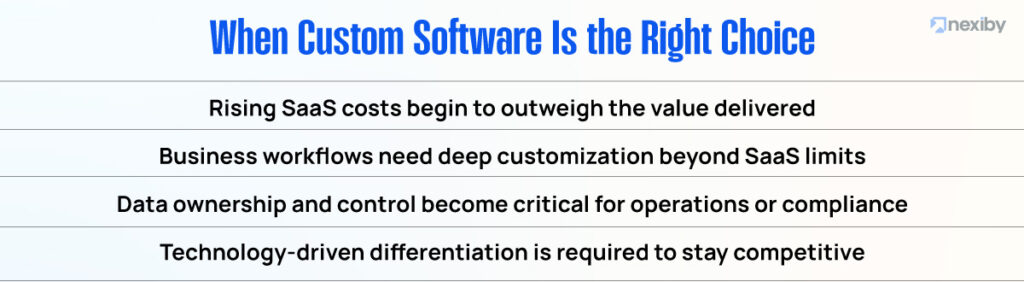
Custom software is not necessary for every business. However, it becomes the right choice when SaaS begins to hinder growth rather than enable it.
Enterprises should consider custom solutions when SaaS costs escalate, workflows require deep customization, data ownership is critical, or competitive differentiation depends on technology. For many US enterprises, this tipping point arrives as they scale operations and complexity.
Recognizing this moment early can prevent years of inefficiency and unnecessary expense.
The Future of Enterprise Software
The future of enterprise software is not defined by abandoning SaaS, but by moving beyond blind adoption. US enterprises are entering a more mature phase of digital strategy, where ownership, flexibility, and long-term value matter more than speed alone.
Custom proprietary software is reclaiming its role as the foundation of enterprise operations. Organizations that invest in owning their technology stack gain resilience, adaptability, and strategic advantage.
Moving beyond SaaS is not a step backward. It is a deliberate step toward sustainable growth, innovation, and control.
Frequently Asked Questions
1. Why are US enterprises moving away from SaaS platforms?
Rising costs, limited customization, data ownership concerns, and vendor dependency are pushing enterprises toward custom solutions.
2. Is custom proprietary software more expensive than SaaS?
Upfront costs are higher, but long-term total cost of ownership is often lower than SaaS subscriptions.
3. Does custom software scale better for enterprises?
Yes. Custom software scales according to business needs rather than vendor pricing models.
4. How does custom software support AI and automation?
Custom solutions allow deeper AI integration, proprietary data usage, and advanced automation without platform restrictions.
5. How can Nexiby help with custom software development?
Nexiby designs secure, scalable, enterprise-grade custom software tailored to US business needs.