
Choosing a custom WordPress or a pre-built theme should be driven by your business goals. Use a pre-built theme if you prioritize speed and budget. Opt for custom development when scalability, brand alignment, or advanced features are essential. For complex workflows, custom builds protect your investment in the long term.
Focus on what fits your business needs. The wrong choice leads to higher long-term costs, not just inconvenience.
What’s the Difference Between a Custom WordPress Site and a Pre-Built Theme?
A pre-built WordPress theme gives you a ready-made design you can install and launch quickly. Options like Avada, Divi, and GeneratePress are built to suit many types of websites. Because of that, you often get extra code, features, and styling you may never actually use.
Custom WordPress development builds your site from the ground up. A developer codes PHP, CSS, and JavaScript. They create custom content types, features, or plugins you need. Nothing extra is added.
The main differences are performance, flexibility, and ongoing maintenance.
When is a Pre-Built Theme the Right Call?
A pre-built theme is the right choice when your business priorities are speed, simplicity, and keeping costs low.
- You’re starting a new business and want to test your idea before spending on custom work.
- Your site is simple. A few pages, a blog, or a portfolio. No complex features needed.
- You’re on a tight budget or timeline. And you don’t plan to scale right away.
- Your brand is still taking shape. You don’t want to commit to a custom design yet.
In a nutshell: If you are a local service business that needs a homepage, service pages, an about page, a contact form, and a few trust-building elements, a good theme can do the job. You do not need a custom build just to say what you do and get inquiries.
A well-chosen theme is usually a better investment than custom development that adds complexity without solving a real business need.
When Should You Choose Custom WordPress Development?
Custom WordPress development makes sense when the website needs to support business operations, not just present information.
That usually applies when:
- The site is an important lead or revenue channel
- You need custom content types, advanced filtering, different user permissions, or more complex internal processes
- The website depends on integrations with CRMs, booking systems, or internal tools
- Your brand needs a more distinctive user experience
- Your current theme setup is already creating friction
A simple rule of thumb: once your team is constantly working around a theme’s limitations, custom development starts to make more financial and operational sense.
Custom WordPress vs Pre-built Theme: Quick Comparison
| Factor | Pre-Built Theme | Custom WordPress Development |
| Upfront cost | Lower | Higher |
| Launch timeline | Faster | Slower |
| Design flexibility | Limited by theme | Built around your brand |
| Performance | Depends on the theme quality | Easier to optimize |
| Plugin dependency | Often higher | Usually lower |
| Scalability | Good for simpler sites | Better for growth |
| Maintenance | Theme and plugin dependent | More controlled |
| Security surface area | More third-party code | More direct control |
| Best fit | Simple sites, faster launches | Complex, growth-focused sites |
What Does Custom WordPress Development Actually Cost?
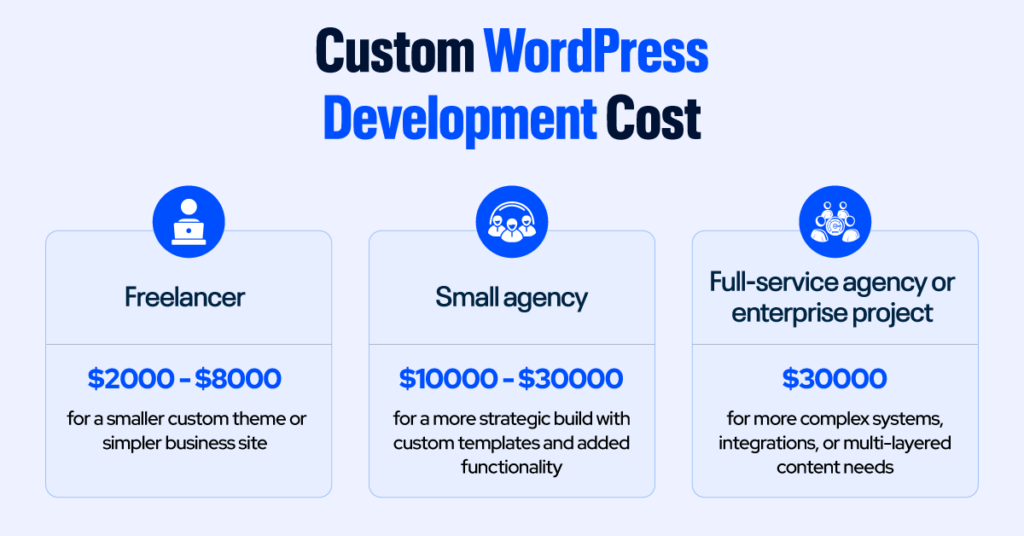
Costs vary widely based on scope, design complexity, integrations, and who is building the site. As a rough guide:
- Freelancer: $2,000 to $8,000 for a smaller custom theme or simpler business site
- Small agency: $10,000 to $30,000 for a more strategic build with custom templates and added functionality
- Full-service agency or enterprise project: $30,000+ for more complex systems, integrations, or multi-layered content needs
The more important question is not just what the site costs to launch, but what it will cost to maintain and improve over the next few years. A lower-cost theme build can become more expensive over time if it leads to plugin sprawl, repeated performance fixes, redesign work, or cleanup that could have been avoided with a better-fit setup from the start.
For a deeper breakdown of pricing factors, check out our detailed guide on What It Really Costs to Build a WordPress Website.
How Do Security, Performance, and Maintenance Differ?
Security
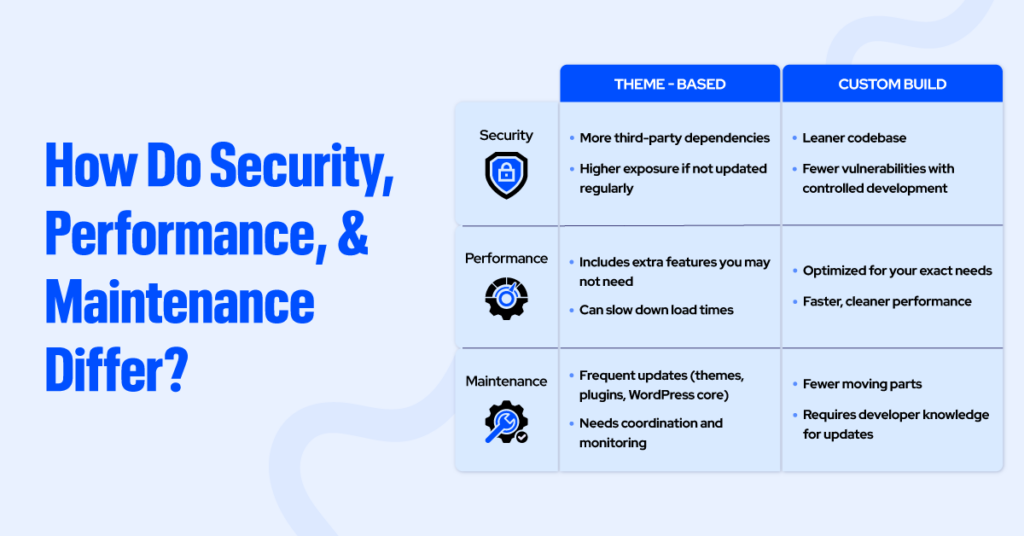
A pre-built theme is not automatically less secure, and a custom site is not automatically safer. The bigger issue is how much third-party code your site depends on. Theme-based sites often rely on more bundled features and plugins, which means more components to update and monitor. A lean custom build can reduce that footprint.
Performance
Performance is often where custom builds have an advantage. Many off-the-shelf themes are built to cover many use cases, so they include extra CSS, JavaScript, and builder features your site may never need. A custom build gives you more control over what loads, which makes optimization easier.
Maintenance
Neither option is maintenance-free. Theme-based sites often require coordination across the theme, plugins, builders, and WordPress updates. Custom sites offer more control, but they usually depend on a developer who understands the codebase. The best option is the one your team can maintain consistently over time.
How Do Pre-Built Themes Affect Core Web Vitals?
Pre-built themes can make Core Web Vitals harder to optimize because they often load code and design features that a site does not fully use. That can increase page weight, slow down the main content, and make pages feel less responsive.
That does not mean every theme performs poorly, but custom builds are usually easier to optimize because you have more control over what loads on each page.
If search visibility and conversions matter, this is a strong argument for choosing the leanest setup possible.
Why Does Choosing The Wrong WordPress Setup Cost More Later?
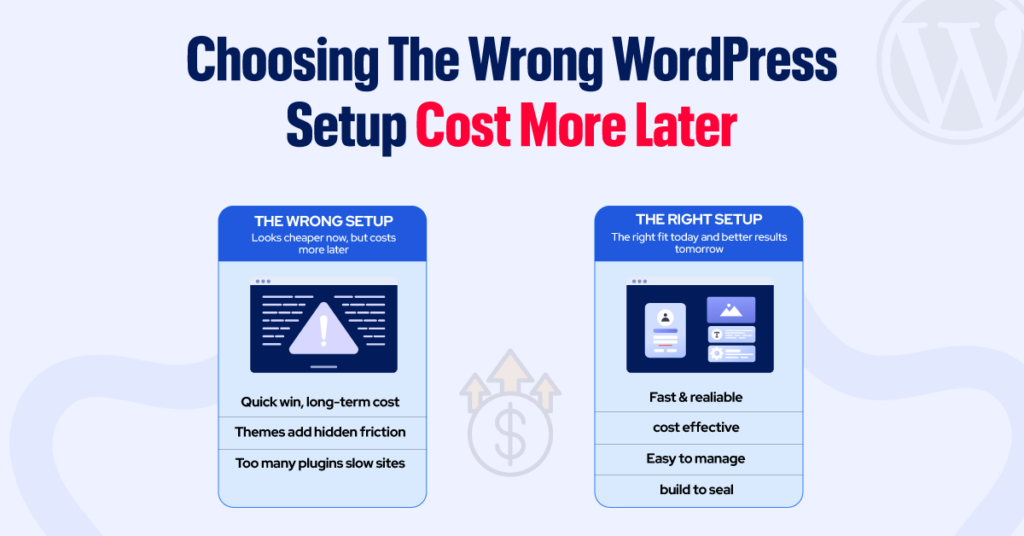
The wrong WordPress setup usually becomes more expensive over time because it creates ongoing friction.
A theme-based site may work well at launch, then become harder to manage as new requirements are added. One plugin leads to another, performance starts slipping, and fixes get layered on top of an already bloated setup. Over time, the site becomes more complicated than it needs to be.
Custom development can also be the wrong choice when the business does not need that level of flexibility yet. If the site only needs a few standard pages and simple functionality, a custom build can add cost and timeline without adding much practical value.
That is why this decision is less about upfront cost and more about choosing the setup that fits your business now and over the next few years.
Checklist: Pre-built Theme vs Custom WordPress
Use this as a quick decision filter.
Choose a pre-built theme if:
- Your site is simple
- You need to launch fast
- Your budget is limited
- You are still testing your business or offer
- Custom functionality is not essential
- A unique design is not your top priority yet
Choose custom WordPress development if:
- Your site drives real business value
- You need advanced functionality or integrations
- You are already hitting theme limitations
- Performance matters to the user experience
- Your brand needs a stronger visual identity
- You want to build for the next few years, not just the next few months
If your website mainly explains who you are and what you do, a theme is often enough. If your website needs to support lead generation, sales, bookings, or internal workflows, custom development usually makes more sense.
Conclusion
There is no universal winner here because the right choice depends on the role your website plays in the business.
A pre-built theme is often the better fit when speed, simplicity, and budget are the main priorities. Custom WordPress development becomes the stronger option when the site needs custom functionality, tighter performance control, a more tailored design system, or room to grow without constant workarounds.
The best choice is the one that fits both your current needs and the level of complexity your site is likely to grow into over the next few years.
FAQ
Can I start with a theme and switch to custom later?
Yes. But in most cases, that is a rebuild, not a minor upgrade. You can usually keep the content, but the design and functionality often need to be reworked.
Is custom WordPress faster than a theme?
Often, yes. But only when it is built well. A lightweight theme on good hosting can still outperform messy custom code.
How long does custom WordPress development take?
Most custom builds take 4 to 12 weeks. A pre-built theme can usually be set up in a few days to two weeks, depending on content readiness.
Do I need a developer to maintain a custom WordPress site?
Not for everyday content edits. You will need one for plugin issues, security patches, or new features, usually handled with a small monthly retainer.
Is a custom WordPress better for SEO than a pre-built theme?
SEO depends on content and technical setup, but custom builds make it easier to control page speed, clean code, and Core Web Vitals.