A long link is hard to share and looks messy. Sometimes it breaks in messages and social posts, which hurts your click rate.
A URL shortener turns a long web address into a short one.
For example: https://example.com/products/summer-sale becomes https://short.link/sale.
But not all shorteners provide the same features and security. Some show ads before redirecting your visitor. Others sell your click data to third parties. And some tools stop working after a few months, which is a problem called link rot.
We tested 20+ free and paid tools for analytics, speed, uptime, privacy, and ease of use. The research focused on which shorteners are secure, keep your data safe, and offer advanced features that are truly valuable. We have selected the 8 best URL shortener websites for you so that you can find the right shortener for your business, budget, and needs.
Key Takeaways
- Shorten messy links to improve clicks and prevent link rot.
- Choose based on longevity, custom domains, analytics, and business support.
- Lupofy is the best free, feature-rich choice for small businesses.
- Rebrandly excels for branding and marketing campaign consistency.
- Bitly is trusted for enterprise reliability and wide tool integrations.
- BL.INK offers high link volume and uptime guarantees for enterprises.
How We Choose the Best URL Shortener Websites
A good URL shortener does not just shorten the link, its metter how the link’s longevity, custom domain, click report, integration & support.
1. Link Longevity
The uptime and speed are the most key points here. If the shortener’s servers go down, or redirects happen more than 50 milliseconds, that will cost your lost user and break the total process. That is called link rot. You should pick a tool that has been around for years or one that lets you self-host.
2. Custom Domain Support
When you use a third-party domain like bit.ly or tinyurl that can trigger the system to treat it as spam. But if you use a custom domain (like go.yourbrand.com/offer) looks professional. And the user will also trust the domain because it matches the brand name (not using a third-party domain).
3. Click Analytics
When a link is shared, this must need to know the total report to understand the overall performance of the links.
A dashboard must show the report:
- Total Number of clicks
- Location of the user (country, city)
- Device type (mobile, desktop)
- Referrer (which website the click came from)
4. Integrations
A URL shortener becomes more useful when it can connect with the tools you already use for business operations.
Top platforms support integrations with automation services like Zapier, allowing you to automatically create and share short links across marketing campaigns, blog content, customer support systems, and internal workflows.
It’s also important to choose a tool that works well with messaging platforms, SMS software, social media scheduling tools, and video-focused platforms such as TikTok.
Whether you are managing affiliate links, running social campaigns, or building a referral program, strong integration support helps improve efficiency, consistency, and scalability.
5. Support
Reliable support can make a major difference, especially when your campaigns, branded links, or customer-facing content depend on uninterrupted performance.
The best URL shortener platforms provide responsive customer support, detailed documentation, and clear onboarding resources to help teams get started quickly. Some also offer dedicated account managers, priority assistance, or technical guidance for larger businesses and enterprise users.
If you plan to use APIs, automation workflows, or custom domains, strong support becomes even more important. Fast issue resolution and helpful guidance can reduce downtime, prevent broken links, and keep your marketing operations running smoothly.
A good platform should not only offer powerful features but also make it easy to get help when you need it most.
The 7 Best URL Shortener Websites (A quick comparison)
| Tool | Best Feature | Best For | Free Plan? | Paid From |
| Lupofy | 1 custom domains on free plan + generous limits | Small businesses, creators | Yes | ~$6/month |
| Rebrandly | Strong branding tools & team controls | Brand‑first marketing teams | Yes (limited) | $14/month |
| Bitly | Enterprise trust & wide integrations | Large companies | Yes (very limited) | $35/month |
| TinyURL | No account needed, links never expire | Quick, anonymous sharing | Yes | $16/month |
| BL.INK | High volume & 99.9% uptime SLA | Enterprise link management | No (21-day trial) | $48/month |
| Dub.co | Open‑source & modern marketing features | Marketing teams | Yes | $30/month |
| Cuttly | All‑in‑one (links + bio pages) | Freelancers on a budget | Yes | $12/month |
The Best URL Shortener We Tested Overall
1. Lupofy

Lupofy is the best all-around URL shortener because it gives you real features on a free plan. Most tools hide custom domains behind a paywall. Bitly requires a subscription to use your own brand in links. Rebrandly limits you to 10 free links per month. Dub gives you 25 free links and 1,000 tracked clicks, which is fair but capped.
But Lupofy goes further. You don’t need to create or log in to an account to shorten URLs. Just paste your link, and it will automatically shorten it in 3 seconds, allowing you to copy it easily. The free plan allows you to add 1 custom domain with 150 active links, unlimited tracking, and automatic QR code generation.
In our testing, we did not find any other tool that combines 1 custom domain, unlimited click tracking, and link shortening without requiring an account.
They also include a built-in link gallery feature that can save you from buying separate subscriptions to Linktree or Beacons for your Instagram or TikTok bio. The dashboard is clean, the redirect speed in our tests stayed under 80 milliseconds across three weeks, and the QR codes can be downloaded in both PNG and SVG formats. That’s great.
The paid plan unlocks team roles, API access, city-level analytics, UTM tracking, and more active links. At $6/month, it is one of the most affordable paid plans on this list.
Best for: Small businesses and creators who want a free, feature-rich shortener with their own branding. Paid plans starting at just $6/month.
2. Rebrandly

Rebrandly is built around a single idea: every link you share should carry your brand, not a third-party domain. It executes that idea better than anyone else on this list.
You get custom slugs, custom domains, UTM builder support, and traffic routing out of the box. Traffic routing lets you redirect users to different pages based on their country, device, or other conditions. This is useful for you to manage campaigns to target multiple regions from one ad.
The standout feature is Rebrandly AI. After you shorten a link, you can click “Boost this link,” and the tool analyzes data from millions of similar links to recommend the best time and day to share it. It can even predict how much your click-through rate will improve. No other shortener on this list does this.
But unfortunately, their free plan is too limited. The free plan allows you to create only 10 links and 100 clicks per month, which we would say is only useful for testing to get an idea about their product.
The Paid plan is $14/month Essentials plan is one of the better mid-tier deals because it does not require an annual contract.
Best for: Marketing teams that run frequent campaigns and need brand-consistent links with smart scheduling. Paid plans start at $14/month.
3. Bitly
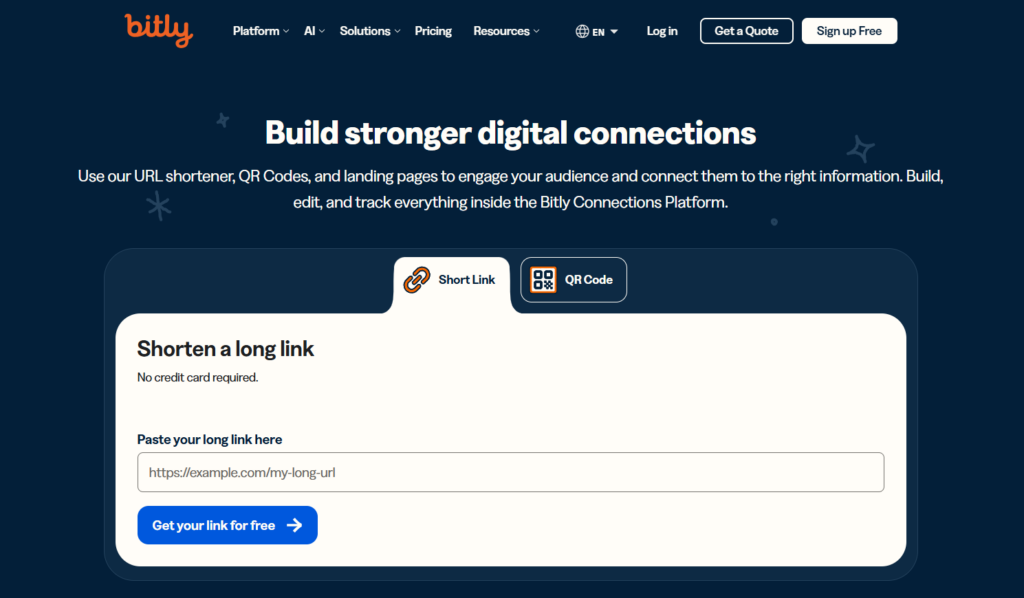
Bitly is the most recognized name in URL shortening. The brand has been around since 2008, and their domain is trusted across email providers, social platforms, and spam filters worldwide. For enterprise teams, that level of domain reputation can be worth paying for.
But the free plan is really terrible. They only allow 10 links a month with only 5 custom URL back-halves. Even if anyone clicks to see the pages, they will see the ads.
Bitly integrates with hundreds of tools and is one of the few shorteners that offers full landing page creation, not just a basic bio link. Paid plans unlock bulk shortening, QR codes, branded domains, custom landing pages, and a UTM builder.
But the main downside is price. The monthly plans start at $35, which is high compared to Lupofy ($6), Short.io ($5), or Dub ($30). If you pay annually, the Core plan drops to $8/month, but you are locked in for a year.
Best for: Large organizations that need reliability, brand trust, and wide integration support.
4. TinyURL
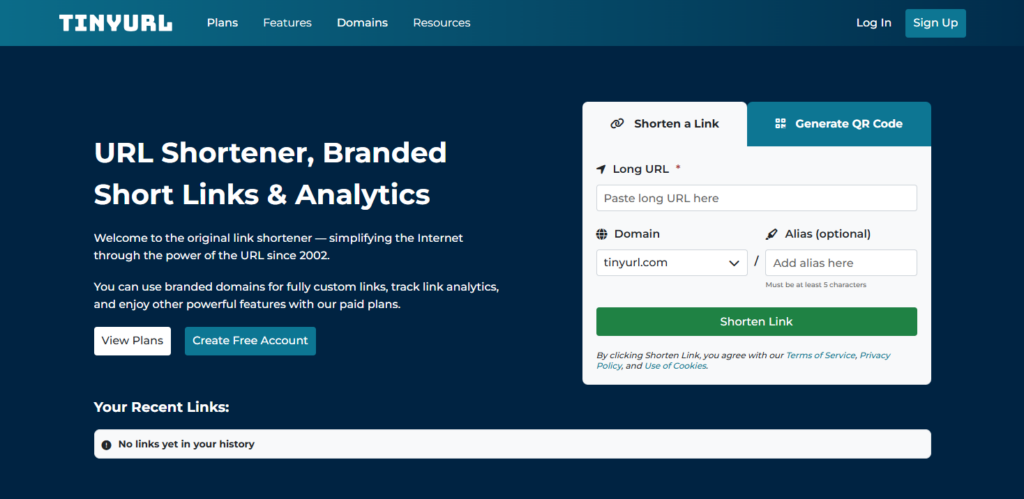
TinyURL has been shortening links since 2002, and they do one thing well: it shrinks a URL in three seconds with no account required. Just paste your long link, add an optional alias, and click Shorten. That’s it.
Useful for you to instantly share without managing a subscription for the public content, support articles, and podcast shows. The TinyURL is hard to beat because the links never expire, and the service does not require a login.
Free users also get one-click QR code generation with downloads in PNG and SVG, which is unusually generous for a free tool.
The trade-off is features. The free version has no analytics, no custom domain, and no integrations. If you need any of those, you need the Pro plan at $16/month or you should pick a different tool.
Best for: Anyone who needs a fast, free, no-login URL shortener. Pro plans start at $16/month.
5. BL.INK

BL.INK targets small businesses and enterprises that manage thousands of links and need a tool the entire team can use. They are more expensive than the other tools here, but the plan limits justify the cost.
The entry-level plan cost is ($48/month), offering 10000 active links, which is more than most competitors offer at any price. The platfrom support Dynamic Links, which let you change the destination of a short link after you have shared it, without updating the URL.
BL.INK also includes a 99.9% uptime SLA, role-based permissions, audit logs, and SOC 2 compliance. The interface is not as clean as (Lupofy or Dub), and the learning curve is steeper. If you need the teams that need collaboration features, role-based permissions, and high volumes, BL.INK is a strong choice.
Best for: Enterprises and SMBs that need high link volumes, team access controls, and uptime guarantees. Plans from $48/month with a 21-day free trial.
6. Dub.co
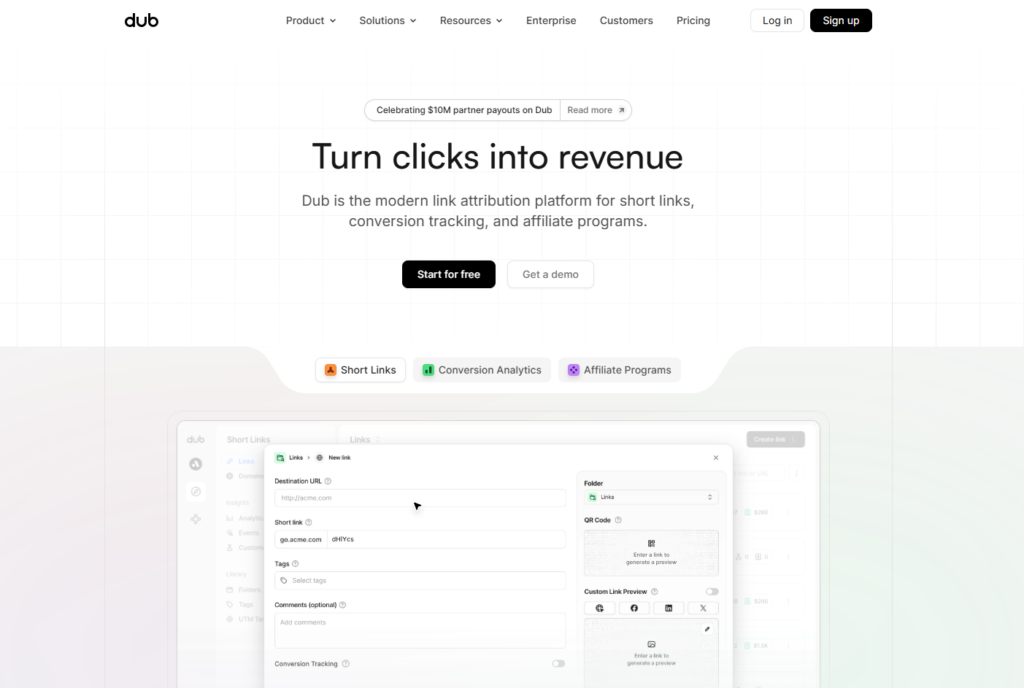
Dub.co is a newer entrant that has grown quickly because they are open-source, transparent, and packed with modern features. You can self-host it for full control over your data, or use the cloud version for convenience.
They offer branded short links, QR codes, advanced analytics, link-in-bio pages, and AI-powered URL slug suggestions. The analytics dashboard is one of the cleanest on this list and is built around the metrics marketing teams actually use — referrers, devices, geographies, and conversion funnels.
We loved their features that allowed us to integrate with modern SaaS stacks, including Framer, WordPress, Raycast, and Slack, plus it has a full REST API. The free plan is usable (25 links, 1,000 clicks, 3 custom domains & 3 users). We count then the 2nd best in the free plan (as Lupofy provides 200 links with more features).
The Pro plan at $30/month adds 1,000 links, 50,000 clicks, advanced link targeting, custom social cards, and more.
Best for: Modern marketing teams that value transparency, clean design, and open-source flexibility. Paid plans start at $30/month.
7. Cuttly
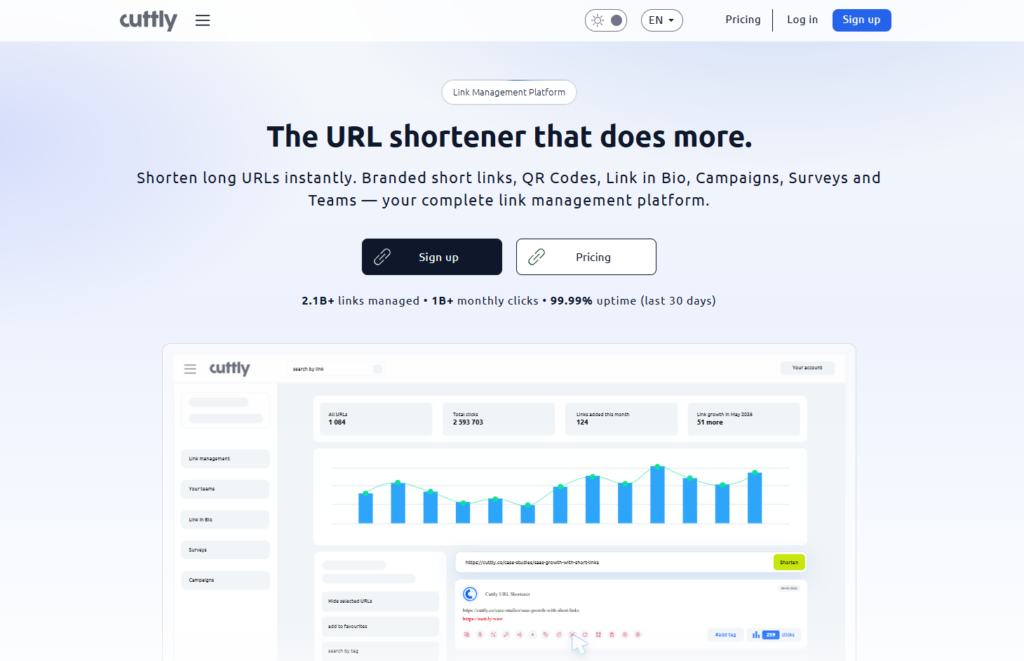
Cuttly bundles URL shortening, QR code generation, and a link-in-bio page into one platform. We choose them for their solid choice for freelancers and small creators who want to manage everything in one place without paying for multiple tools.
The free plan includes basic analytics, QR codes, and a link-in-bio page. Paid plans add custom domains, team access, A/B testing on links, and deeper reporting. If you are looking for a Bitly alternative, then Cuttly is a better choice for you.
Best for: Freelancers and small creators who want a simple all-in-one platform. Paid plans start at $12/month.
Which URL Shortener Website Should You Choose?
With so many strong options on this list, the right pick really comes down to how you plan to use it. Here is a quick breakdown to make it easy for you:
- If you are a solo creator or small business on a tight budget. Start with Lupofy. Two custom domains on the free plan and unlimited click tracking are a deal you will not find elsewhere. Upgrade for $6/month if you need city-level data or team access.
- For your marketing teams to run regular campaigns and care deeply about brand consistency, go with Rebrandly. Branding is where Rebrandly genuinely outperforms the rest. The AI-powered link timing tool alone can boost your click-through rate, and the branding features are the strongest in this category.
- If your team needs links that load every time, look safe to spam filters, and connect to the rest of your stack, then choose Bitly. Bitly has spent more than a decade earning that reputation.
- Need a fast, free link that never breaks? Use TinyURL. No login, no setup, no expiry. Just paste the link, shorten it, and share it. It is the right tool for casual use, support articles, podcast notes, or any link you simply do not want to manage inside a dashboard.
- When your team manages thousands of links and needs uptime guarantees, look at BL.INK. The 99.9% SLA and 10,000-link entry plan are built for serious enterprise operations.
- Prefer open-source tools and modern integrations? Try Dub.co. Clean design, transparent pricing, and a self-hosting option make them the fastest-growing newcomers in this space.
- Looking for one tool that handles links, QR codes, and a bio page without spending much? Cuttly covers all three. It is not the most advanced option, but it bundles the essentials into a single platform with a low learning curve and straightforward pricing — ideal if you would rather manage one tool than three.
- If you want one tool for links, QR codes, and a bio page without spending much. Cuttly covers all three for a reasonable price and with minimal setup.
Final Thought
A URL shortener is a small tool that makes a real difference. Clean links get more clicks. Branded links build more trust. And smart analytics help you understand what is actually working in your campaigns.
The right tool depends on where you are today. If you are just starting out, Lupofy gives you the most value for free. If you are scaling a brand or running enterprise campaigns, Rebrandly, Bitly, or BL.INK will serve you better.
Start with the free plan of whichever tool fits your needs and try it on a real campaign before paying for anything. Once you see how much cleaner your links look and how much more you learn from your traffic, you will wonder how you ever shared raw URLs in the first place.
Frequently Asked Questions
Are free URL shorteners good enough for business?
Yes, if you choose the right one. Lupofy offers a custom domain and unlimited tracking for free, which is enough for most small businesses.
What is link rot?
It is when a short link stops working because the shortener shuts down. Pick a long-established tool or one with a 99.9% uptime guarantee to avoid it.
Do I need a custom domain for short links?
It’s built trust. Branded domains like go.yourbrand.com build trust and avoid spam filters, unlike generic third-party domains such as bit.ly.
Can I shorten links without creating an account?
Yes. TinyURL and Lupofy both let you shorten links instantly with no login, no setup, and no expiry on the links you create.