Two paths sit in front of every SaaS founder today. You can build wide, or you can build deep. That choice shapes your funding, your team, your moat, and your exit.
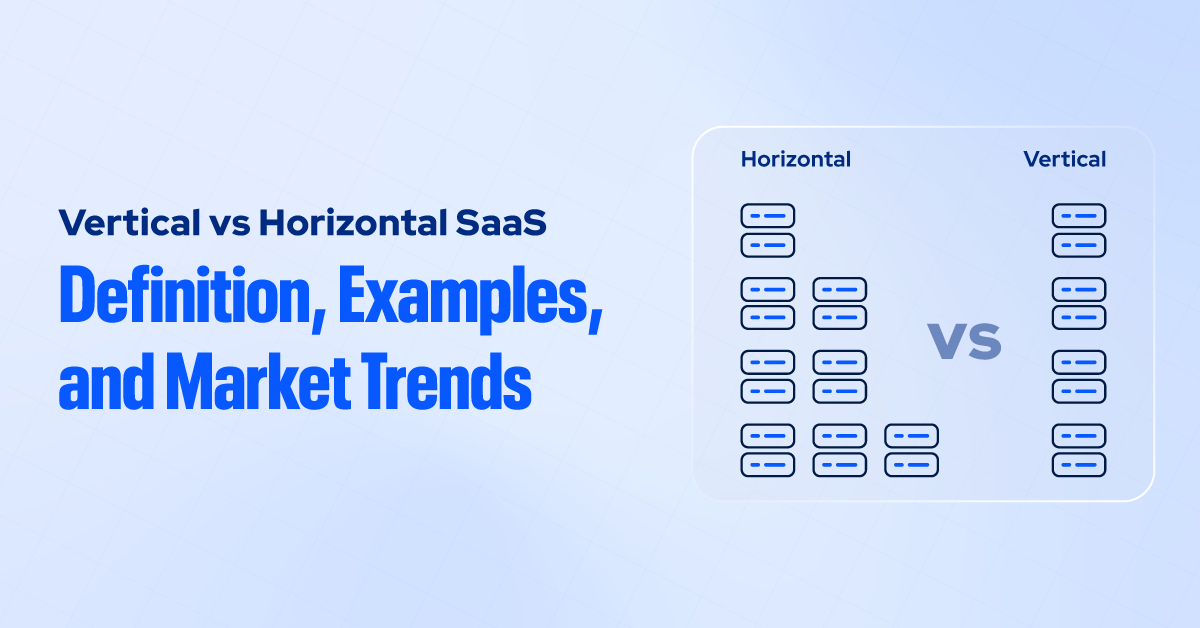
Horizontal SaaS sells one tool to every industry. Vertical SaaS sells a full system to one industry. Both can win. But in 2026, the market is rewarding one path more than the other.
This guide breaks down the latest market data, real examples, and a clear decision framework to let you know which model fits your idea, your background, and your goals. Let’s dive in.
What Is SaaS, Anyway?
Before moving on to the vertical and horizontal Sass, let’s deep dive into Sass itself.
SaaS (Software as a Service) is a cloud-based delivery model where the application is hosted and maintained by a third-party provider, and you access it through a web browser on a subscription basis. The simple way to think about it is that you’re not buying the software at all; you’re renting the service it provides for as long as you need it.
Like your electricity at home. You actually do not own the power plant; you just flip a switch and pay a small bill each month for what you actually use. SaaS works in exactly the same way, with the provider running the entire machine in the background while you simply open your browser and get to work.
Once software became easy to deliver, founders started building it for every niche under the sun. Which brings us right back to our main question: should that niche be wide (horizontal), or should it be deep (vertical)?
Let’s start with wide.
What Is Horizontal SaaS?
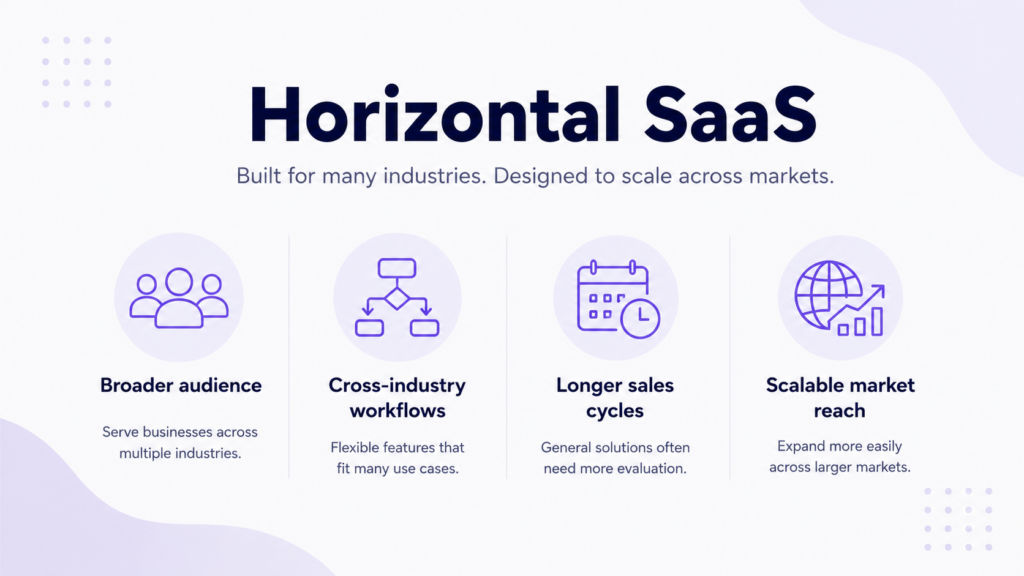
Horizontal SaaS is software built to solve one common problem across multiple industries, regardless of who the customer is.
This icp does not care if you sell shoes, run a law firm, or build rockets; instead, this build tools that solve all of the problems.
Every business needs to chat with its team, track deals, and manage projects, and horizontal SaaS shows up to fix those big, shared problems.
A few names will probably ring a bell here:
- Salesforce (CRM), which powers sales pipelines for banks, hospitals, and tech startups on the same core platform.
- Communication tools like Slack. That helps teams everywhere talk, share files, and run projects from one place.
- A Marketing automation tool, HubSpot, which targets to use any company to send emails, build landing pages, and score leads without much setup.
- And Productivity tools like Asana and Notion. They build to handle tasks, docs, and team projects for just about every kind of business.
Horizontal SaaS wins on scale. The buyer pool is huge because almost every business is a possible customer. That makes the pitch simple. “Track your deals.” “Talk to your team.” Easy to understand.
Best for: Solving general, cross-industry problems like sales, marketing, communication, and project management, where the core workflow stays the same no matter who’s using it.
What Is Vertical SaaS?
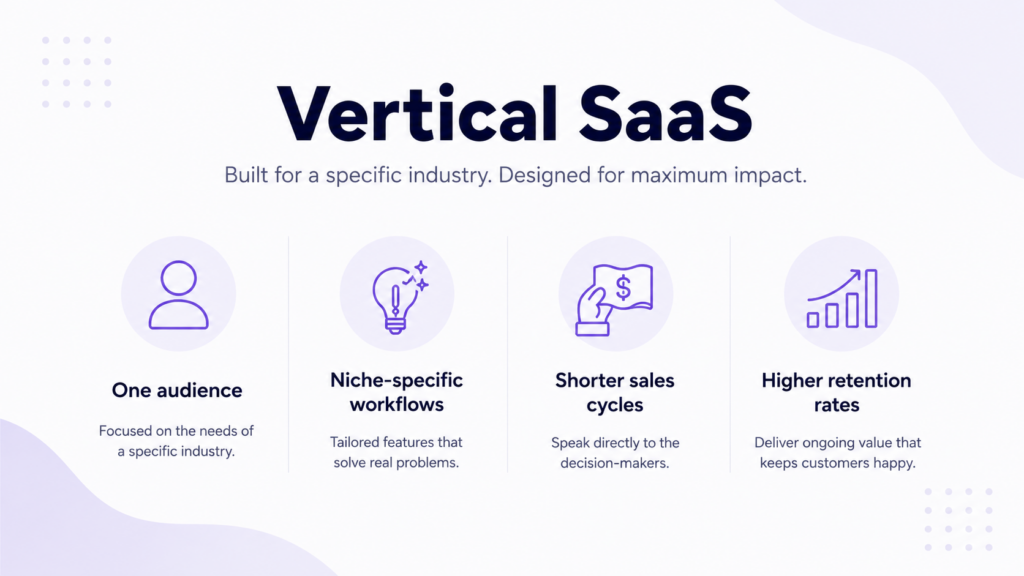
Vertical SaaS is built for just one specific industry, and nothing else. The goal is to serve one type of business and solve their every problem very well. For example, a dental clinic may use software that is designed to track patient scheduling, insurance claims, and treatment history. On the other hand, a construction company needs different things; they might use a platform built to manage job sites, equipment tracking, and contractor workflows.
Best for: Solving deep, industry-specific problems where workflows, compliance rules, and customer needs are too unique for a generic tool to handle well.
The 2026 Market Reality: By the Numbers
Now let’s look at what’s actually happening in the market. The numbers tell a clear story, and the story is vertical SaaS is having a moment in all of B2B software today.
Market Size and Growth
The vertical SaaS market hit $143.45 billion in 2026, and it’s on track to reach $499.42 billion by 2035. That’s a 16.3% CAGR, according to Business Research Insights.
Horizontal SaaS is still growing too, but at a slower pace, around 12 to 15% through 2030, per SaaS Mag. That gap might look small year to year. Over 10 years, it’s massive.
Investor Sentiment
Money tells a clear story. Vertical SaaS pulled in over $18 billion in venture capital in 2025, a 40% jump from the year before, per Tech Insider. Investors are paying attention.
And it’s not just VCs. 89% of executives and IT leaders say vertical SaaS is the future of the sector, according to Qubit Capital.
Retention and Revenue Quality
This is the part where you really see the real difference between the two models. Net revenue retention, or NRR, shows how much your customer base grows over time, even after losing some.
Vertical SaaS NRR often goes over 130%, per Tech Insider. That means customers spend more with you each year, on average.
Sales also tend to be more efficient. Vertical companies often see 40 to 50% better sales efficiency than horizontal ones, per Modall. A closer fit means quicker sales and lower costs.
Market Penetration
As the market demands, Vertical SaaS is growing because of this focus on the only niche-specific problem and working on solving it. Vertical SaaS companies now hold over 40% market share within the industries they serve, per SaaS Validation. That’s the kind of position competitors find really hard to break into, and it’s what turns a good SaaS company into a category-defining one.
Vertical vs. Horizontal SaaS: 7 Key Differences
A quick breakdown to see side by side for you:
| Factor | Vertical SaaS | Horizontal SaaS |
| Target market | One specific industry | All industries |
| Total Addressable Market(TAM) | Smaller but deeper | Larger but broader |
| Product depth | Workflow-specific, end-to-end | Generic, modular |
| Sales cycle | Shorter inside your ICP | Faster to validate, slower to close the enterprise |
| Pricing power | High, fewer direct rivals | Lower, lots of alternatives |
| Net revenue retention | Often 120 to 140% or more | Usually 100 to 115% |
| Switching cost | Very high, baked into operations | Lower, easier to swap out |
Pros and Cons: A Founder’s Honest Comparison
Every model comes with trade-offs, and it’s worth knowing both sides before you pick.
Vertical SaaS, Pros and Cons
Vertical SaaS shines when your goal is to serve one industry the right way. Because the product fits so closely, customers stay longer, pay more, and rarely look elsewhere.
- Pros: Blue ocean, Higher retention, stronger moat, better valuations.
- Cons: Smaller market, harder to pivot, requires deep domain expertise to build and sell.
Horizontal SaaS, Pros and Cons
On the other hand, horizontal is massive TAM, faster validation, and easier marketing. You can target almost any business with a particular solution. As we discussed before, it can be a payment solution, a communication solution, and more.
- Pros: Diversified market risk, viral scalability, faster product validation.
- Cons: High competition, severe churn risk, expensive marketing (CAC), weaker product defensibility.
Both models can win. It really comes down to what kind of company you want to build and who you want to target.
Decision Framework: Which Model Is Right for Your Startup?
The honest answer is that it depends on who you are and what you know. Here’s the short version of how to decide.
Go vertical if you have deep experience in one industry, can name your first customers today, and see clear gaps that horizontal tools haven’t fixed.
Go horizontal if the problem you’re solving shows up in many industries at once, your product gets stronger with more diverse users, and the workflow stays the same no matter who’s using it.
Still not sure? Lean toward vertical. Today’s market rewards focused, industry-specific players more than ever, and a strong vertical play is easier to defend than a generic horizontal one.
And whichever direction you choose, the right software development partner can make the path a lot smoother, since strong teams bring research, market insight, and engineering together to help you validate the call before you build
Final Take
The 2026 market isn’t saying that horizontal SaaS is dead. Not even close. What it’s saying is that vertical SaaS is where the cleanest growth, the strongest margins, and the best exit multiples are sitting right now.
So here’s the simple version. Pick vertical if you have deep industry roots and can name your buyers today. Pick horizontal if your problem is truly universal and you can move fast. Or take the hybrid path: start broad, then go deep.
The model is your choice. The data just tells you which choice is paying off most right now.
Whatever you pick, the best move is to start. Talk to customers. Build something small. Learn. The strongest SaaS companies of the next decade are being built right now, and there’s still plenty of room at the table.